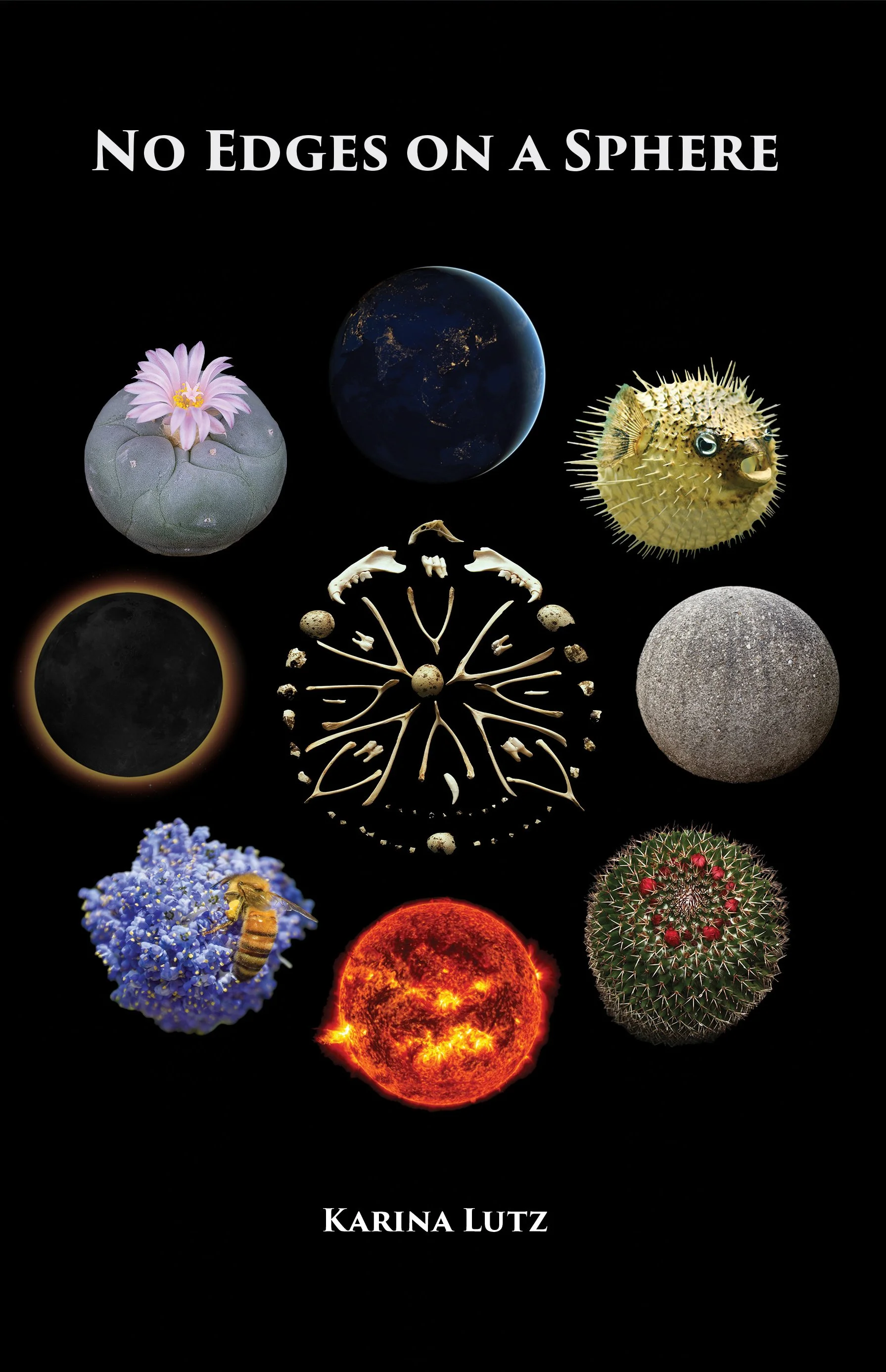
Center of photo: bone mandala by Kristen Zellmer
No Edges on a Sphere
by Karina Lutz
Available on this page November 2026
About No Edges on a Sphere……..
Karina Lutz's latest collection of poems, two epic ekphrastic poetry sequences and a section of shorter poems, address the tangled issues of war, land “ownership,” colonization, genocide, and the war on earth itself. The poems trace those cultural diseases through decades of struggle to heal a country, the United States, of its lethal militarism. Meanwhile, the peace and justice movements have responded, symbolized by the Tibetan Wheel of Time (kalachakra) mandala coming down from the Himalaya at the same time westerners go to space and see Earth whole. Her home country, the United States, has been at war Lutz's whole life, yet her poems awaken a keen sense of the peace and beauty of earth that concur regardless. The poems honor that peace without denying the horrors of war. The book is a deep bow to the peacemakers she has known and walked along with on peace pilgrimages: the final poem envisions pilgrims may one day encircle the whole earth.
Advance praise for No Edges on a Sphere
Poetry is not right for everyone, but I wish it was, and this collection is one of the reasons why.
No Edges on a Sphere begins with an ordinary yet extraordinary awakening. The poet’s astonishment is not only depicted by but held within the closely observed. Right away we’re inside the story, and the author is right along with us. It’s our journey too after all.
I’ve know the author for a long time, but these poems easily insist on standing alone, and so they do. Alone, that is, until the co-ceation of encounter begins. To absorb these poems is to make them your own, and that, my friend, is well worth it. They are poems good enough to evoke revery even as they contemplate calamity.
This is a collection where the closely observed reveals its mysteries, and these mysteries are all around. The aesthetic of these poems is exquisitely refined, yet they live in the here and now we all share and that is the playing field of our hopes and struggles.
This collection is full of what might seem like magic tricks, but which are simply damn good art: poems good enough to invite revery even when they insist on the contemplation of calamity. If the chthonic was ever political, it is here. And there is wisdom found in minute particulars as well as in cosmic insight.
“Now is the time, once awakened, to act,” says the poet. Yes, indeed. But this is how good these poems are: they are never didactic, and a line like this lands not as annoyingly hortatory, but as a simple statement of fact.
There are lines throughout this work that could well be needlepointed into samplers. The last section alone of this collection, “by walking,” is reminiscent of Thoreau’s “Walking,” and like Thoreau Lutz makes her way “a la Sainte Terre.”
“Bones to the maple” is a worthy and elegiac grace note to W. S. Merwin’s “Vixen.”
Her “In praise of farmers” is written by a farmer herself, and you can tell she’s earned the closing line “Some still sleep while others rise, too, with the pink-grey sky.” Here, as with the whole collection, she knows from which she speaks.
In “Encircling earth, the center of our gravity,” when she describes monks making their sand mandala, she is speaking from experience. And once again you can tell: “…a representation in form, perhaps, of love, of belonging, of what brings us home,” is a homecoming worthy of closing this collection.
And a end worthy of Hildegard.
I began by pointing out that poetry is not for everyone. Yet great art creates its own audience, so these poems just might be for everyone. Open this book and find out.
Some things are dangerous to read, writing so good that it is dangerous to encounter because to read it and to not change your life is to do yourself great harm. But go ahead, risk it. These poems are worth the risk. —David Heckman, a life-long progressive activist and poet
Powerful work, Karina ….
In these days, we want to avert our eyes to the turmoil … kudos to you for standing in the fire and bringing voice to what is calling for attention and compassion!
It takes incredible courage to name things as they are. In No Edges on a Sphere, Karina Lutz brings our awareness to what most of us would rather not see, from war to violence and to the sorrows of our time. When we can name the darkness, though, we make more room for light. This poetry is a witness to it all, as a lament, a prayer and a most of all, a call to awaken to what is most important. —Jonathan Foust, Founder and Senior Teacher, the Year of Living Mindfully
Such powerful truth telling, medicine weaving and a potent prayer for peace, healing and justice is this brave, brilliant poetry.
-—Aravinda Ananda, co-author of Coming Together in the Great Turning: Collective Liberation and Work That Reconnects
These bright poems go to the heart of the matter and our souls in turns of phrase that are clever and sharp. There is truth here. Pain. Clarity. Love. And hope because surely in seeing us as we have been, as we are, and as we might be Lutz shows us we must do something. We can do something.
You are so gifted. Thanks for sharing the book.
—Neta C. Crawford, Costs of War co-founder and author of The Pentagon, Climate Change, and War
Karina’s poetry is scripture, guiding us into the depths and wildness of the living Earth in all its forms, confronting us with the cruel insanities of modernity while reminding us of the beauty, vitality, and intelligence available to us in every moment, in every breath, in birth and death. Reading these words, I remember.
I've never read anything wiser than these poems. They are scripture! I am in awe.
—Molly Brown, co-author with Joanna Macy of Coming Back to Life, founding editor of Deep Times
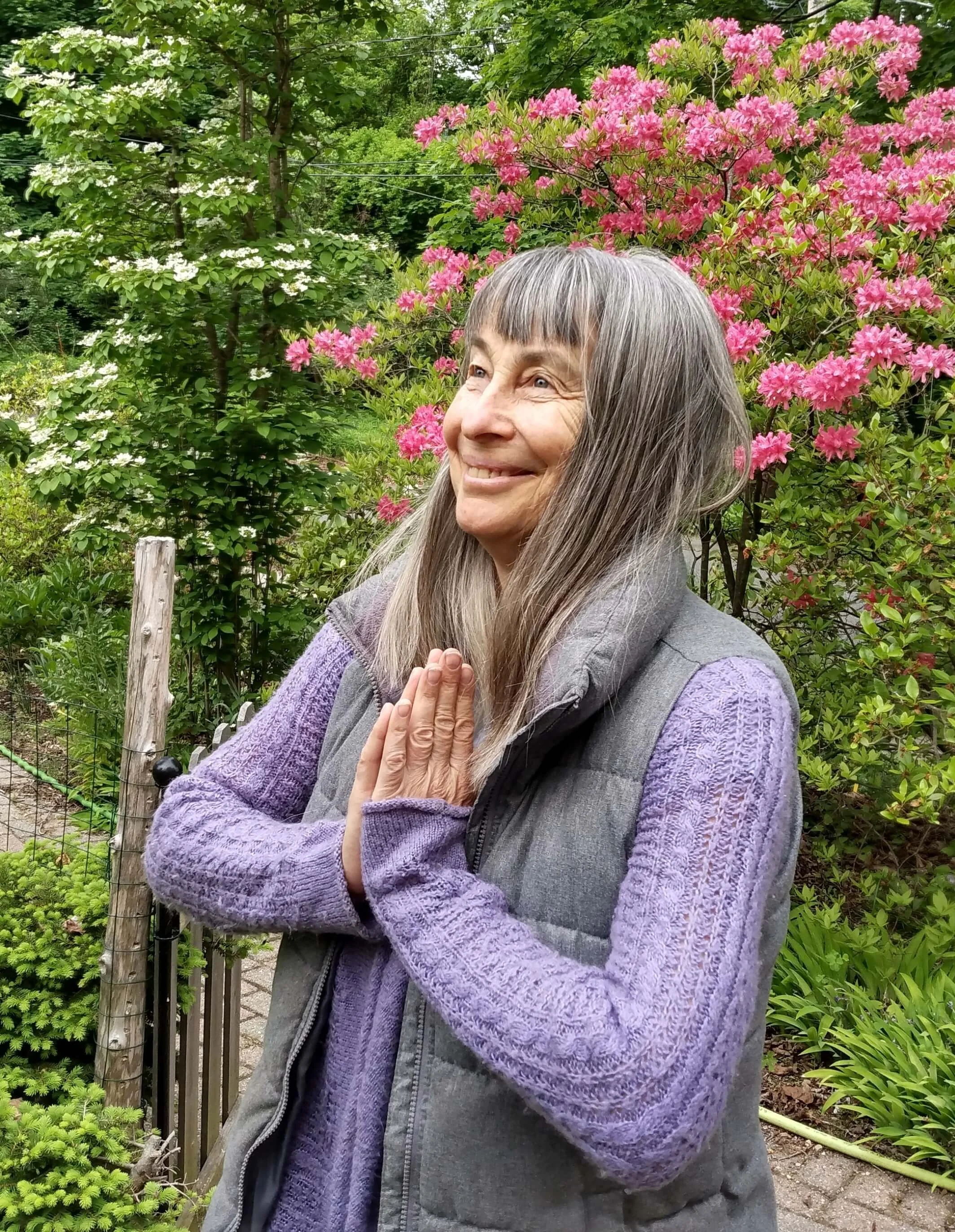
Karina Lutz (photo by Emily Baron)
About the Author
Karina Lutz's life has been a net thrown wide to gather experience, ever since her first writing teacher gave her the classic maxim: “write from experience.” She worked making food, clothing, and shelter; and reporting, editing and publishing; and in social services and teaching, all while writing and volunteering for social justice. She's always been particularly wedded to the peace movement, after following her mother gathering signatures to stop the Vietnam War, while her naval reserve officer father slowly converted to come out against the war. Professionally she worked as an environmental activist, advocating for sustainable energy and a stable climate, and helped launch one of the first nonprofit green power companies. With the environmental community in the watershed of Narragansett Bay, she secured passage of sustainable energy legislation, thwarted a proposed megaport, and restored wetlands. Yet she failed to stop the climate crisis, as we used to say, “before it is too late, when you can feel it.”
Towards the end of her career, she and friends co-created an intentional community, Listening Tree Cooperative, which demonstrated low-carbon living, social permaculture, ecological restoration, and regenerative farming, while sharing affordable housing and farmland.
Karina's poems are widely published. Her books are Post-Catholic Midrashim and Preliminary Visions. She was the first poetry editor of Deep Times: A Journal of the Work That Reconnects. And she's written a play, a novella, and a novel. She's performed the epic contained in this book, “Encircling Earth” in dozens of venues, from sustainable living festivals to Quaker meeting houses. She's also walked the walk: doing a peace pilgrimage around New England in the middle of the US wars in Iraq and Afghanistan.
Her two children have two children; her four sisters are a sisterhood of contenders; her friends light up the sky. She loves to dance with all of them. She loves the humans the way some people love dogs.